What is acupuncture?
Acupuncture is a form of medicine that has been practised for thousands of years. It involves the use of very fine needles placed at specific points on the body.
Rather than focusing on one isolated symptom, acupuncture looks at the body as a whole. Treatment is based on how different aspects of your health are interacting, including physical symptoms, energy, sleep and emotional wellbeing.

How does acupuncture work?
In traditional acupuncture, the body is understood as a connected system. Treatment works by supporting how that system functions, rather than trying to override it.
In practice, this means looking at patterns across your health, not just one symptom, and using acupuncture points to help bring things back towards balance.
You don’t need to understand the theory in detail for treatment to be effective, although I am always happy talking through it.

What happens during a session?
Sessions include time to talk as well as time for treatment.
At your first appointment, we’ll go through your health history and what you’d like support with. This helps shape your treatment from the start.
Follow-up sessions are adapted based on how things are changing and responding over time.

A whole-person approach
Acupuncture is often used as part of a broader approach to health.
Alongside treatment, you may receive simple, tailored advice around lifestyle, rest, or daily routines, depending on what’s relevant to you.
The aim is not just to address symptoms, but to support your overall sense of balance and wellbeing.
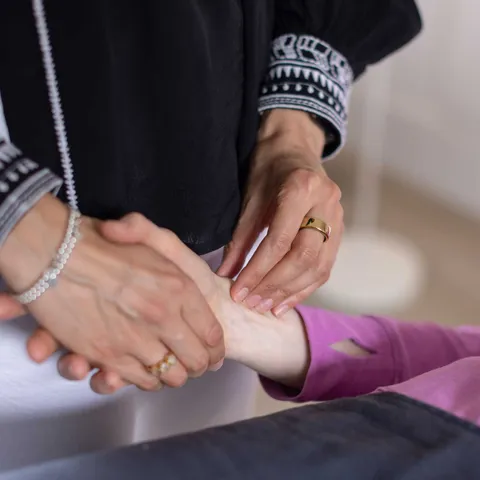
Additional therapies
In some cases, treatment may also include other traditional techniques, depending on what’s appropriate.
These can include:
- Moxibustion - gentle heat applied to specific points
- Cupping - used to release tension in the body
- Gua sha - a light scraping technique to support circulation
- Electro-acupuncture - a mild electrical current used in certain cases
- Auricular acupuncture - points on the ear used to support different areas
Not all treatments include these. They’re used selectively, depending on your needs.

Common questions
Does acupuncture hurt?
The needles used are very fine, much thinner than those used for injections.
Most people feel little to no discomfort. You may notice a mild sensation such as tingling, warmth or heaviness, followed by a sense of relaxation.
Is acupuncture safe?
Acupuncture is widely used and generally considered safe when practised by a qualified practitioner.
Members of the British Acupuncture Council complete extensive training and follow strict safety and hygiene standards.
Do I need to believe in acupuncture for it to work?
No. Many people come with little or no prior experience. Treatment is based on how your body responds.
How quickly will I notice a difference?
This varies depending on what you’re coming for. Some people notice changes quickly, while for others it builds more gradually.
Chinese vs Western acupuncture: what’s the difference?
Western acupuncture, sometimes called dry needling or medical acupuncture, is adapted from Chinese acupuncture but does not usually use the same traditional theoretical framework.
Western acupuncturists are often GPs, nurses, osteopaths or physiotherapists. British Acupuncture Council-accredited training involves over 3,600 hours of study, giving practitioners a deep grounding in both traditional Chinese medicine theory and safe clinical practice.
What is the British Acupuncture Council?
The British Acupuncture Council, or BAcC, is the UK’s leading professional body for traditional acupuncturists.
Membership means a practitioner has met rigorous clinical, ethical, academic and safety standards.
If you’re new to acupuncture
It’s completely normal to have questions before trying something new. If you’d like to talk things through, or feel ready to begin, you’re welcome to book an appointment.